Dr. Eric Topol recently discussed his research at the Scripps Research Translational Institute in a Wall Street Journal article. A prominent health and longevity authority, his new book Super Agers is on the study of exceptionally healthy people 85 years and older, seeking to understand what they did right. What caught my eye: DNA sequencing of these “super agers” didn’t reveal significant genetic uniqueness that set them apart from others who didn’t age as successfully.
Nature vs. Nurture: Focus on What You Can Change
Is successful aging determined by nature or nurture, genetics or behavior? I believe in focusing on things we can change rather than those we can’t. Many studies call this “modifiable risk factors” – and where we should direct our attention. How do we best play the hand we’re dealt, rather than lamenting the cards we received?
Which is why I found the list from Scripps Research and Topol’s book interesting. DNA sequencing of these super agers didn’t find a lot of uniqueness that set them apart from other people that didn’t age as successfully. That said, as a group they had significant commonalities:
They were thinner, exercised more, and were better educated. They stayed socially active, and did activities that gave them purpose in life. (which may be why many retirees I know who were successful at work and are aging successfully engage with volunteer activities, or a part time business. In other words – doing something)
I strongly agree with these findings and follow many of these principles myself. Having read extensively on aging successfully (and even written a book on the subject, Stand Taller Live Longer – A Posture & Anti-Aging Strategy, I’d like to share my thoughts on Dr. Topol’s modifiable behaviors.
5 Modifiable Behaviors for Successful Aging
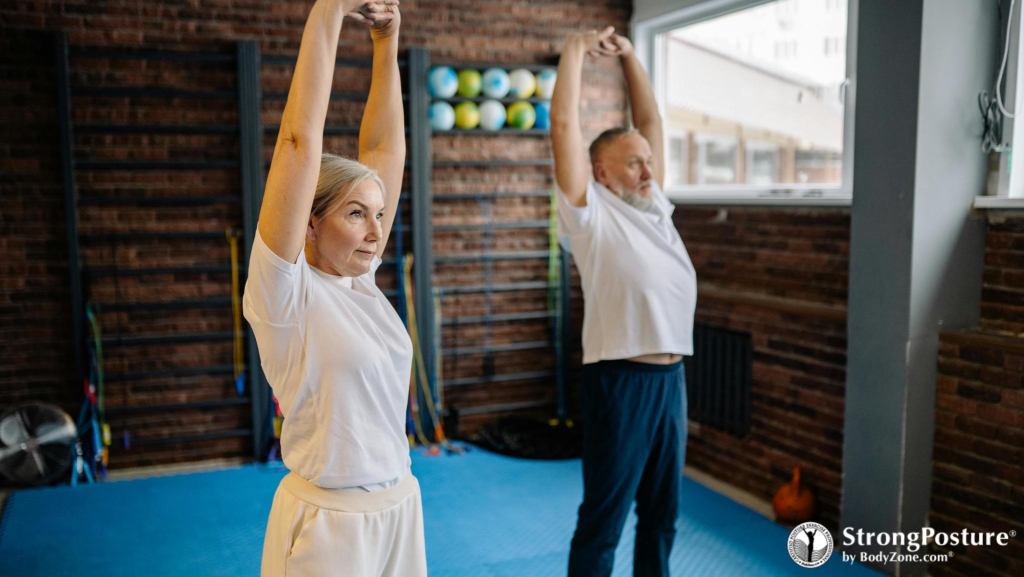
1. Exercise: It’s Not Just If You Move, But How You Move
Dr. Topol confesses that as a cardiologist, previously he mainly emphasized aerobic exercise but now acknowledges that a tremendous amount of research provides evidence that strength training is really important as well. I completely agree but believe this still leaves out crucial aspects of movement.
What’s often missing from successful aging advice is this: it’s not only if you move, it’s how you move. The habits, injuries, and pains accumulated over a lifetime impact our movement patterns.
Over time, posture symmetry subtly shifts – first compensating, then structurally adapting as some muscles are relied on too much and get or stay stronger, while others are neglected and weakened.
These movement patterns continually strengthen, creating adaptive patterns as we use some muscles out of their natural pattern, which over time impacts balance. As we age, our bodies naturally lose muscle mass. Neglected muscles lose more mass more quickly, causing progressive breakdown of posture patterns and balance.
This was one of my key points in discussions when I served as a delegate to the White House Conference on Aging: How we move, the loss of fluid connections between many small motions linking to create whole body movement is a hidden factor behind the crisis of fall injuries. Then, as now, I advocate for a few minutes daily of individualized posture and balance exercises integrated into everyone’s regular exercise routine.
2. Sleep: Quality Over Quantity
Dr. Topol recommends seven hours of sleep instead of eight. I personally agree, but that’s a personal opinion from my body and my Oura ring… I don’t know about your body.

3. Diet: Whole Foods and Proper Nutrition
I completely align with eating whole foods, eliminating processed foods and embracing natural, organic options like oil and vinegar dressings and adequate protein. While Dr. Topol has increased his protein intake, I’ve moderated mine. Nevertheless, as I no longer try to finish an 8 ounce protein (much less a 16 ounce steak), I suspect we’ve converged at similar levels.
4. Know your Body, and Be Aware
In Super Agers, Dr. Topol advocates for genetic testing with at-home kits but doesn’t specifically weigh in about any nutritional supplements, taking the position that anti-aging compounds’ effect on aging has not been proven. I would expand this to being more aware of both the structure of your unique body, and how it functions biomechanically. Knowing your genetics isn’t a bad thing, but it’s fixed, and only actionable as a guide to predisposition. Despite the influence of weakly understood epigenetic factors, general behavioral habits like keeping your body moving and eating food with greater nutritive value and less synthetic petrochemicals is probably a good idea…even though it is not fully “evidence proven”.
Not being proven is my critique of Topol’s perspective as a researcher. Over the past 45 years as a doctor of chiropractic, I’ve seen my profession grow from being a completely unproven healthcare fringe to generally acknowledged as “good for back pain.” Today, I know many medical colleagues doubting the wisdom of “old school” medicine, especially pharmaceuticals marketed for lifetime care as opposed to helping people change their behaviors to be healthier. This could be the reason the AMA has devolved from being perceived as a quasi-public health organization supported by dues from more than half the nation’s doctors in 1990, to a shrinking union of barely 12% of practicing doctors today.
To be “evidence-proven” requires time, researchers, and lots and lots of money. Large scientific studies, meta-studies, meta-analysis, and network meta-analysis synthesize multiple studies. Not being proven doesn’t mean it’s not true – it means it hasn’t been adequately tested… yet (which may be economic, political, or the academic trend at the time).
My conviction is to learn and be aware of my body and the emerging research supporting intelligent behaviors to be healthier and happier. In other words, learn, try some things, learn how my body works, and make a choice to incorporate that into my behavior. If you haven’t seen it, stream “Groundhog Day”—it’s an old Bill Murray movie about a guy who gets multiple chances to learn to do each day right.
Whether it’s for next 10 thousand days, or 30,000 days, my takeaway is we should all pay attention to be aware of what works for our unique life and body.

5. Mental Health: The Nature Connection
Emphasizing improving mental health by spending more time outdoors and in nature is wise – a recommendation I strongly endorse. It’s part of choosing activities that make sense for us as individuals that don’t have significant downsides, and incorporating them into our daily routines and habits.
That’s why I’m writing this outside, with my morning coffee, after reading the above article in today’s paper. It’s a daily habit I maintain because I truly believe that being outside and continuous learning helps improve mental health, which helps us to keep moving well to age well.
Putting it into Practice
Help patients integrate these concepts. See this new continuing education module on Balance, Movement & Posture and Clinical Nutrition.
For more information on the connection between posture and aging well, read “Stand Taller Live Longer: A Posture & Anti-Aging Strategy” and visit StrongPosture.com to take the 7 Steps to StrongPosture® self-care program.
Posture Awareness: A Key to Aging Well
Posture Month Tip:
Become more posture-aware to move well and improve control of posture and balance. Check out the free 31 days to StrongPosture® self-care program at StrongPosture.com to learn more about maintaining proper posture for longevity.

Dr. Steven Weiniger
Dr. Steven Weiniger is a leading expert in age-related health optimization who developed the StrongPosture® rehabilitation methodology. He’s trained thousands of healthcare providers worldwide in evidence-based techniques for healthy aging and longevity. His recent work focuses on body awareness and movement accuracy, contributing to innovative strategies for actionable health improvements. Dr. Weiniger’s expertise has been featured across major media networks and healthcare journals.