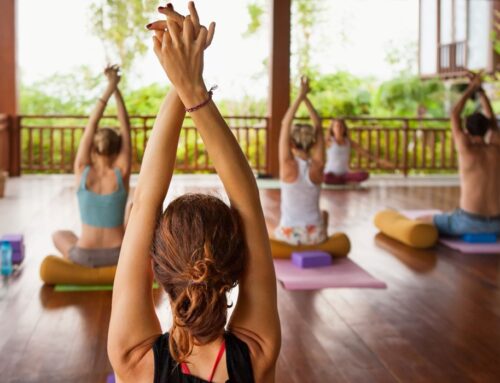
Moving slowly & smoothly with the expansion and contraction of your respiration is what yoga is all about.
One of the things I have experienced in my practice of yoga and massage is that we can all use a little “smoothing out” of the rough edges in our lives. Whether it be “time crunches,” or simple repetitive motions, we often move without a thought to how we feel in the process. We just want to get where we’re going, or get something over with.
It’s my feeling that when we invest a little time in feeling the wonderful movements of our human anatomy, and sense its incredible smoothness, that we can really calm down, and enjoy life more. Dr. Larry Dossey, MD formerly at the Dallas Diagnostic Center made a practice of asking his patients during one period of time to close their eyes, and open them in a minute (60 seconds.)
Well, with most of them, their eyes were opening in about 20 – 30 seconds. This confirmed the existence of what he termed “time sickness,” or feeling time is going 2 – 3 times faster than it really is! In practicing our yoga postures, we will be really slowing down the rate at which we move our bodies.
During my days of ‘assembly line massage,’ at a Southern resort town, it dawned on me one day: “if fast paced, repetitive motion puts stress into peoples muscles, joints and tissues, then I’ll bet slow motion, thoughtful movements would help to unwind this excessive tension.” Sure enough, when I moved a persons’ limbs or neck very slowly, it began to loosen. These subtle stretches began to combine with my previous yoga training, and some very beautiful breathing and movement patterns occurred right before my eyes, and with only minimal guidance or effort from me.
In the practice of yoga, this is basically what we’re doing: stretching our bodies into a variety of positions very slowly, and holding that pose while breathing very deeply out and then in. It is important to stretch as we inhale, after exhaling fully.
In this way, we’re letting go of any excess tenseness, or frozenness in the muscle or joint, then expanding into a new “freedom of movement” and posture. The classic yoga term for the poses we do is called: a’sana meaning posture “comfortably held.” So, it’s not necessary to overstrain getting into the pose, or to hold it too long. Just the right amount of stretch, and “holding time” for you is the right way.
Also, the number of repetitions for each pose is flexible, however 2 – 4 times is usually good. We’ll find that most times, we can stretch a tiny bit more on the second or third times, & begin to loosen up so much more than if we just do each pose once. Therefore, it is better to pick say 3 – 4 poses and use those in ones practice.
A few final recommendations: it’s best to have an empty stomach for at least 3 hours before doing yogic a’sanas, and to wait a half hour before eating so our systems can assimilate what we just did.
Drinking a couple glasses of water before our routine can greatly aid in stimulating our awareness of our bodies’ as flowing, fluid beings. Yoga simply helps us begin to move again as we did as babies, or like cats, who as I see it are natural yogis.